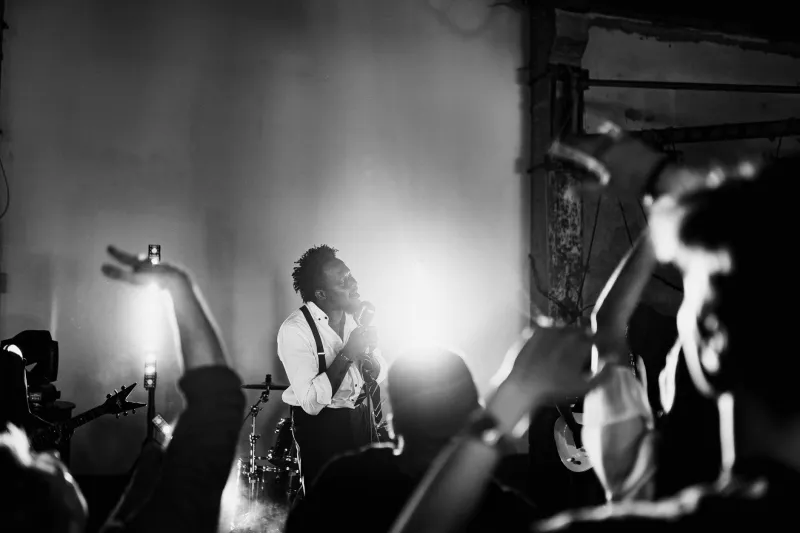
There's a version of success in the entertainment world that looks a lot like a highlight reel — perfectly timed drops, carefully curated aesthetics, and a PR team working overtime to sand down every rough edge. Then there's the Bob Stenstrom version, which looks a lot more like a conversation you'd have with a friend over coffee. And somehow, against every conventional piece of industry wisdom, that second approach is the one that's actually working.
In 2024, when the noise online reached a kind of deafening peak, something counterintuitive started happening: audiences began gravitating toward the artists who weren't trying so hard. Bob Stenstrom had been doing this all along — and now the rest of the industry is finally catching up.
The Manufactured Persona Problem
For years, the playbook for breaking through as an artist involved layers of packaging. You needed a brand identity, a visual language, a carefully managed social presence, and ideally a team of consultants to help you stay on message. The logic made sense on paper. Stand out, stay consistent, control the narrative.
But audiences — especially younger American fans who grew up watching reality TV get exposed as scripted and Instagram aesthetics get mocked for being fake — developed a finely tuned radar for inauthenticity. When something feels manufactured, people disengage. Not with anger, just with indifference. They scroll past.
Industry observers have started calling this the "persona fatigue" effect. Fans aren't just bored with polished content — they're actively suspicious of it. Marketing strategist Dana Whitfield, who consults for independent artists across the Midwest and Southeast, put it plainly in a recent interview: "The audience in 2024 isn't looking for perfection. They're looking for proof that you're actually in the room with them."
Bob Stenstrom has always been in the room.
What "Authentic" Actually Means in Practice
The word "authentic" gets thrown around so much these days that it's nearly lost its meaning. Every brand claims to be authentic. Every influencer pitches themselves as "real." So what separates genuine transparency from performed transparency?
The answer, when you look at Stenstrom's trajectory, has less to do with what he shares and more to do with what he doesn't hide. Setbacks, creative dead ends, the unglamorous grind between milestones — these aren't things he sweeps under the rug. They're part of the story he tells, and fans feel that difference.
Compare that to the artist who posts a vulnerability moment specifically designed to go viral, complete with a professional photo shoot and a caption workshopped by a social media manager. Even if the underlying emotion is real, the packaging signals something else. It says: I am performing honesty for you. Audiences know the difference, even if they can't always articulate why it feels off.
Stenstrom's approach isn't accidental sloppiness — it's a deliberate commitment to letting the work speak louder than the marketing apparatus around it.
The Numbers Back It Up
Here's where it gets interesting from a career sustainability standpoint. Artists who build audiences on authenticity tend to retain those audiences at significantly higher rates than those who build on hype cycles.
Hype works — nobody's denying that. A well-timed viral moment can generate enormous short-term numbers. But the fans who show up for the spectacle often leave when the spectacle fades. What Stenstrom has cultivated is something closer to loyalty than fandom in the traditional sense. These are people who feel invested in the person, not just the product.
That distinction matters enormously when you're thinking about long-term career health. Ticket sales, merchandise, direct support — all of these revenue streams depend on sustained engagement, not peak virality. An artist with 50,000 deeply connected fans will consistently outperform an artist with 500,000 passive followers when it comes to the metrics that actually keep a career alive.
Emerging Artists Are Taking Notes
Across the country, a new wave of artists is quietly studying what Stenstrom has built and applying similar principles to their own work. The approach varies — some lean into long-form video content that documents their process, others prioritize direct fan communication over broadcast-style posting — but the underlying philosophy is consistent: stop performing and start connecting.
A singer-songwriter out of Nashville told a music industry podcast earlier this year that she'd deliberately stopped using a content calendar after watching how organic Stenstrom's engagement felt compared to her own heavily scheduled output. "I was posting on a schedule, but nothing was landing," she said. "I started just sharing things when I actually had something to say, and the response completely changed."
That kind of shift — from content strategy to genuine communication — is subtle but profound. And it's happening more frequently as the Stenstrom model gains visibility.
The Influencer Economy's Blind Spot
The influencer economy, for all its sophistication, has a fundamental blind spot: it optimizes for reach at the expense of depth. Algorithms reward content that generates quick reactions — shares, comments, saves — and so creators learn to produce content designed for those reactions rather than content that actually means something.
Stenstrom operates mostly outside that loop, not because he's technologically averse, but because he understands that chasing algorithmic approval is a race with no finish line. The platform changes. The algorithm updates. What worked last quarter stops working this quarter. Artists who've built their entire strategy around gaming these systems find themselves starting over every 18 months.
Building on genuine connection, by contrast, compounds. Every real interaction creates a stronger foundation. Every honest moment shared deepens the relationship between artist and audience. That's not something an algorithm update can erase.
What the Playbook Looks Like Going Forward
If 2024 taught the entertainment industry anything, it's that the old assumptions about what drives success need serious reexamination. The artists who are thriving — not just spiking, but genuinely thriving — are the ones who figured out that their audience wants a relationship, not a product launch.
Bob Stenstrom didn't invent authenticity. But he's been one of the clearest demonstrations of what it looks like when an artist commits to it fully, without hedging, without packaging it into something more marketable. The result is a career that doesn't depend on the next big moment to survive — because the foundation is solid regardless of what the moment is.
For emerging artists trying to figure out their path through the noise, that might be the most valuable lesson 2024 has to offer. The playbook isn't about going viral. It's about being worth coming back to.
And that, more than any algorithm or PR strategy, is what Bob Stenstrom has quietly been proving all along.