Between the Takes: What Bob Stenstrom Actually Says When Nobody's Performing
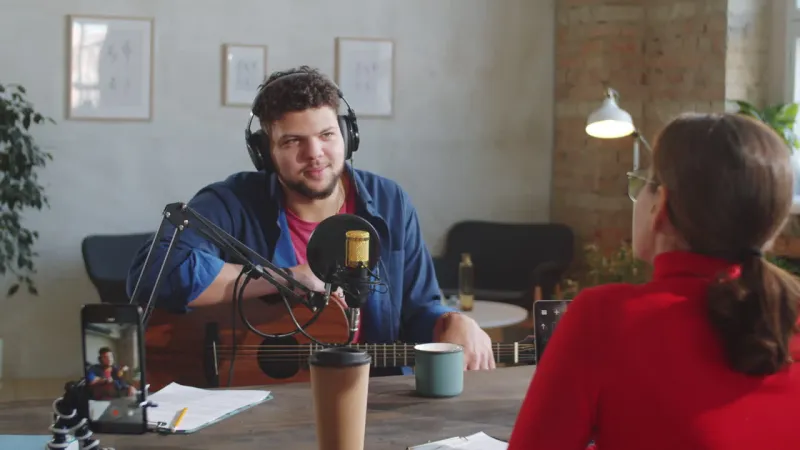
Photo: musician candid podcast interview behind the scenes creative process documentary, via videocdn.cdnpk.net
There's a version of Bob Stenstrom that exists in the finished work—polished, intentional, crafted. And then there's the version that shows up in a two-hour podcast conversation at 11pm, or in a shaky behind-the-scenes video shot on someone's phone, or in a video diary entry that feels like it was never meant to be particularly significant.
That second version is the one worth paying attention to.
Over the years, Bob has accumulated a body of candid public appearances that don't get nearly the same attention as the headline projects. But if you spend time with those conversations—the podcast slots, the documentary footage, the rare diary-style content—patterns start to emerge. Recurring phrases, consistent frameworks, the same ideas surfacing in different contexts. Taken together, they reveal a working philosophy that's more nuanced than any single quote can capture.
Here's what those moments actually show.
The Podcast Circuit as Thinking Out Loud
Bob's podcast appearances are interesting precisely because they're not press junkets. He's not usually there to promote a specific release. He's there because someone found him interesting enough to invite, and the conversation tends to go wherever it goes.
What comes through consistently in those settings is how much of his creative process is genuinely iterative and uncertain in real time. He doesn't talk about his work like someone who had a clear vision and executed it. He talks about it more like someone who kept making decisions under incomplete information and occasionally got lucky that the decisions added up to something coherent.
That's not false modesty. It's actually a more sophisticated understanding of creativity than the "I had a vision" narrative that gets attached to successful artists after the fact. The retrospective clarity is often invented. The actual process is messier, and Bob seems more comfortable than most acknowledging that.
One thread that shows up repeatedly: his relationship with the gap between what he hears in his head and what he can actually produce. Rather than treating that gap as a failure, he's talked about it as the engine of improvement—the persistent dissatisfaction with his own output is what keeps him reaching. If you're familiar with Ira Glass's famous quote about taste and ability, Bob is essentially living that framework, just with his own language around it.
What the Documentary Footage Reveals
Behind-the-scenes documentary content is a different kind of window. Podcast conversations are still, at some level, performances—you're aware of the mic, aware of the audience. Documentary footage, especially the less-produced variety, catches people in the middle of things.
What Bob's documentary appearances reveal, more than anything, is his relationship with boredom. Or more precisely, his refusal to pathologize it. There are stretches in creative work where nothing is happening, where you're waiting for something to click, and the cultural conversation around productivity tends to treat that waiting as a problem to be solved.
Bob doesn't seem to see it that way. In multiple behind-the-scenes moments, he's visible in what looks like deliberate stillness—not scrolling, not filling the silence, just sitting with the work in progress. It's a small thing, but it's consistent enough to be meaningful. The willingness to be bored, to let a problem marinate without forcing a solution, is increasingly rare and increasingly valuable.
There's also something notable about how he handles disagreement in collaborative settings when the camera's rolling. He's not conflict-averse, but he's also not performatively combative. The disagreements tend to be specific and technical—about whether this choice serves the work—rather than personal or territorial. That's a hard thing to maintain under pressure, and seeing it in unscripted moments suggests it's genuinely how he operates, not just how he presents.
The Video Diary as Unfiltered Process Documentation
The rarest content in Bob's public catalog is the video diary material—the stuff that feels most personal and least produced. These entries don't follow a format. They're not trying to teach anything. They're just Bob processing, out loud, whatever's happening in the work at that moment.
What makes them valuable for fans and aspiring artists alike is exactly that lack of agenda. There's no lesson being packaged. There's just someone working through something in real time, which means you get to see the actual texture of creative decision-making rather than the cleaned-up retrospective version.
A few things stand out across these entries:
He changes his mind a lot, and he's fine with it. There are multiple instances where he describes a direction he was certain about in a previous entry, then casually mentions having abandoned it. No drama, no extended explanation. Just: that didn't work, here's where I am now. The willingness to treat prior certainty as just another data point is something most people struggle with.
He talks about influences in specific, technical terms. Not "I was inspired by this artist" in the vague, press-release sense, but "I was trying to figure out how they achieved this specific effect and whether I could do something adjacent." The specificity signals genuine engagement rather than name-dropping.
He's honest about what he doesn't know. There's a recurring acknowledgment in these entries that some things about his own work remain opaque to him—why certain choices feel right, why certain directions feel wrong. Rather than constructing a post-hoc rationalization, he often just sits with the uncertainty.
The Mindset Shift That Shows Up Everywhere
If there's one thing that unifies all of these candid appearances—the podcasts, the documentary footage, the diary content—it's a particular orientation toward time and outcome.
Bob doesn't seem to be optimizing for any single moment. He's not chasing a specific milestone or measuring himself against a specific timeline. The frame is longer than that. He talks about wanting to still be doing this in twenty years, about being curious what he'll think of current work from that distance, about the difference between what gets attention now and what holds up.
That long-horizon thinking shapes everything. It's why he can absorb a project that doesn't land without it feeling catastrophic. It's why he can say no to things that would accelerate short-term visibility but compromise long-term creative integrity. It's why the day-to-day uncertainty of the creative process doesn't seem to destabilize him the way it does a lot of artists.
The finished work is impressive. But the thinking behind it, glimpsed in these unguarded moments, is what actually explains how it gets made.